Box3D.NET
An idiomatic C# binding for Box3D, the 3D physics engine by Erin Catto, with no managed allocations on the simulation hot path.
dotnet add package Box3D.NET
using var world = new PhysicsWorld();

Body ground = world.CreateStaticBody(new Vector3(0.0f, -0.5f, 0.0f));
ground.AddBox(new Box(new Vector3(50.0f, 0.5f, 50.0f)));

Body ball = world.CreateDynamicBody(new Vector3(0.0f, 10.0f, 0.0f));
ball.AddSphere(new Sphere(0.5f));

for (int frame = 0; frame < 120; frame++)
{
    world.Step(1.0f / 60.0f);
}

Console.WriteLine(ball.Position);   // resting on the ground
That is the whole API for a first simulation: a world, some bodies, shapes on them, and a step. Everything else is opt-in.
Getting started · Guides · Examples · API reference
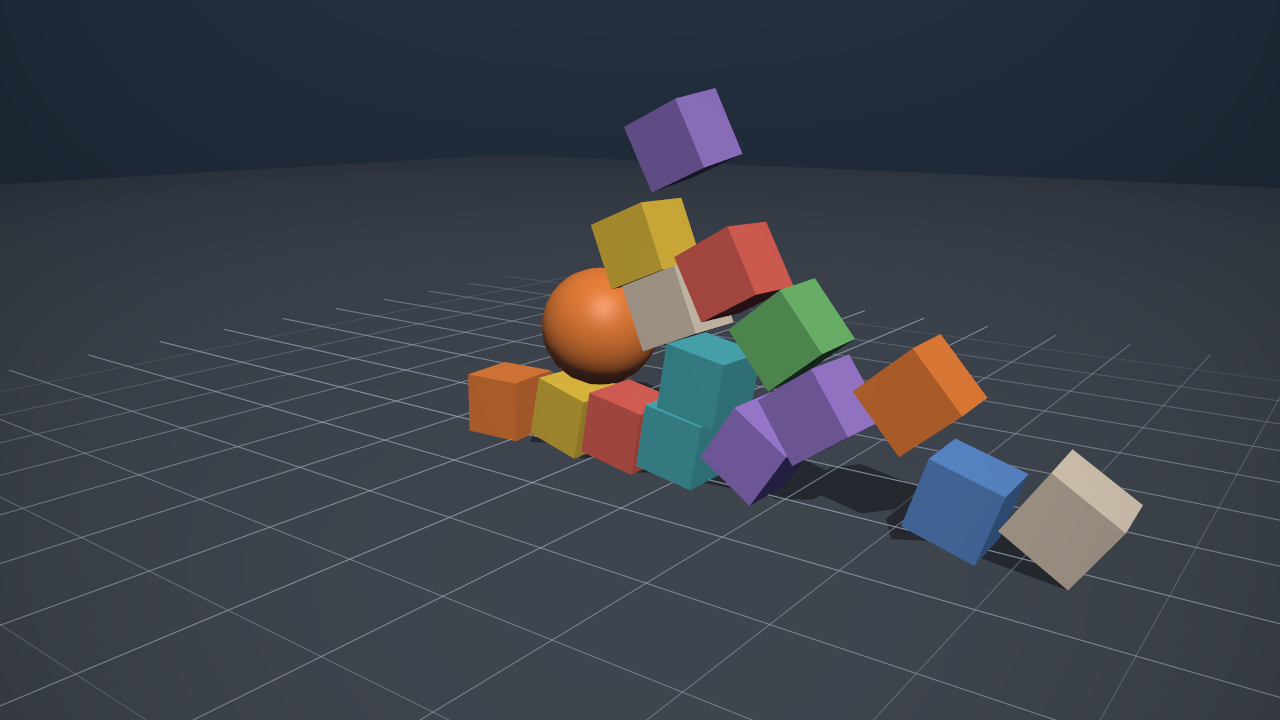
What you get
- Worlds, bodies, shapes, queries, events, all nine joint types, meshes, height fields, baked compounds, the character mover and debug draw.
- Zero managed allocations on the simulation path, including query callbacks, event enumeration and a drawn debug frame. Held to it by tests, not by assertion.
System.Numericstypes at the boundary, so no conversion between physics and your renderer.- .NET 8 or later, Windows, Linux and macOS, x64 and arm64, NativeAOT and trimming.
- No dependencies beyond the base class library. The native binary ships in the package.
Two packages
| Package | What it is |
|---|---|
Box3D.NET |
The idiomatic surface. This is what you want. |
Box3D.NET.Native |
The raw P/Invoke layer, a one-to-one mirror of the C API. |
Box3D.NET validates its input and never names a native type in public API.
The native layer is the escape hatch for the
functions it does not cover yet, reached deliberately through a using.
What it costs
Reading a body position through the wrapper costs 9.50 ns against the C API's 9.00 ns. A whole step is indistinguishable from the C API at 100, 1,000 and 10,000 bodies. Queries allocate nothing, including the callback forms.
Benchmarks has the method and the conditions.
Where to go
| Getting started | Install, first simulation, the loop |
| Guides | Bodies, shapes, queries, events, joints, terrain, characters |
| Concepts | The step, ownership, handles, threading, the native layer |
| Examples | Sixteen runnable samples |
| Gallery | Nine scenes, animated, drawn through the public interface |
| API reference | Every public type |
Status: 0.x. The API may still change between minor versions; every break is recorded in the changelog, and packages are validated against the previous release so none happens by accident.